Journal
Notes from the studio
Essays on craft, technology, and the ideas behind what we build.

Cheating the forgetting curve
A śloka you learn today is mostly gone by next week — that is not a failure of willpower, it is a law of memory first measured in 1885. Shlokas does not fight the curve; it schedules around it, with two small schedulers and a fifty-year-old algorithm.
Read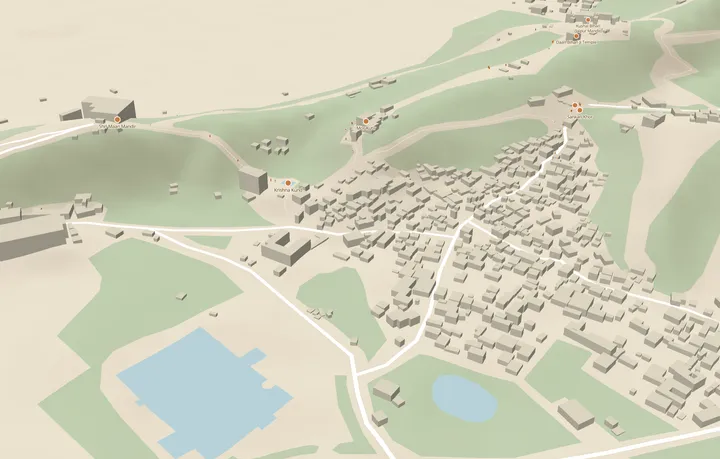
Where a pilgrim's map comes from
Dham Navigator works with the radio off — every street, hill, building, temple and footpath is already on the phone. Here is exactly where all of that data comes from, what format it lives in, and how we make it.
Read
The day the reviews piled up
Textbook spaced repetition tells you the perfect day to review each verse — and if you obey it literally, it hands you sixty cards on Tuesday and four on Wednesday. Here is the small, slightly mischievous change that spreads the load without breaking the math.
Read
Why recall beats reading
Reading a verse over and over feels like learning and mostly is not. The opposite — dragging it out of an empty memory — feels like failing and is the thing that works. That inversion is why Shlokas never lets you re-read, and it is what separates a memory app from a library.
Read
Answers that cite their sources
Building a conversational guide that never invents — how we store the corpus, what we throw out before the model ever sees it, the cheap cosine gate that decides "do we even know this?", and why "I don't know" is a measured number, not a mood.
Read
What we mean by “Software with a Soul”
A studio is shaped by the things it refuses to compromise on. Here is ours — and why a slogan became a way of working.
Read
Denoising without scrubbing the voice
Decades-old lectures arrive with tape hiss, hum, and static. The hard part is not removing the noise — it is removing the noise without eating the voice, gating pauses to dead silence, or inventing sound that was never there.
Read
One chat, every language
The corpus is mostly English; users arrive in Russian, Ukrainian, Serbian. Instead of pre-translating everything, the chat has a translation layer that translates quotes and fragments as it answers — and stores each translation once, beside its original, so it stays fast and the source is always one tap away.
Read
Where the thirty seconds went
Our assistant answered in 30–40 seconds. The culprit was not the language model at all — and the fixes were four old ideas: measure first, filter early, wait in parallel, and only work hard on the hard questions.
Read
Stories you can watch
Ask about a moment from Śrīla Prabhupāda's life and the answer is no longer only text — short video clips come back, disciples telling how it was.
Read
A library that tends itself
Over 5,400 lectures gathered into one place — with a smart library that downloads what is next, clears out what you have heard, and always keeps something ready offline.
Read
Building for the kill switch
To keep the app reachable in Russia — even if the country is cut off from the outside world — we built a complete, self-sufficient copy of the infrastructure inside it. Two of everything, by design.
Read
A citation a model cannot fake
A cheap model invented citation IDs and timecodes out of thin air. The fix was not a smarter model — it was to never show it an ID at all.
Read
Defense in depth against hallucination
A language model will confidently invent a lecture, a quote, a citation. Keeping it honest is not one clever prompt — it is a discipline in three movements: fetch the right data, throw out the wrong data, and only then let the model speak.
Read
An assistant for the lectures
Instead of leafing through hundreds of recordings by hand, you ask a question — and get ready-made fragments from the lectures on your topic.
Read